
Start with the hard parts connected.
Collections, authentication, authorization, realtime, files, and jobs share one backend. Spend your effort on the behavior that makes your product useful.
Explore the capabilities →Small team. Serious software.
An extensible Zig backend for ambitious applications. Integrated services, explicit resource control, and a single binary you can make your own.
Write it yourself. Build with a frontier coding agent. Use both.
The framework puts you in control.
npx zigbase initQuick start →Typed hooks · routes · jobs · plugins
Auth · data · files · realtime · admin
Allocators · pools · build-time features
One foundation. Room to build something different.
Application leverage. Systems control.
Collections, authentication, authorization, realtime, files, and jobs share one backend. Spend your effort on the behavior that makes your product useful.
Explore the capabilities →Use explicit allocation, inspectable resource profiles, and pool overrides. Compile optional features out. Compare measured configurations against your memory and latency budgets.
Why the language matters →Embed ZigBase as a library. Add trusted business operations, integrations, and custom plugins in Zig, alongside the records and transactions they depend on.
Open the framework reference →Your workflow belongs here
The same public APIs, compiler feedback, and local tests support both. No AI service or subscription required.
Write ordinary Zig against typed hooks and capability APIs. Follow runnable examples, test business logic in process, and generate a typed client from your schema.
Follow the tutorialBrowse recipes →Start with generated project instructions. Give your agent CLI discovery, structured output, stable error codes, and tests it can run to check its work.
Set up your agentInspect the evaluation evidence →The framework is the foundation
Model a booking, approve a request, or integrate a service. Compose custom code with the built-in backend through App(cfg): schema, hooks, routes, jobs, and plugins checked at compile time.
Request-scoped capabilities give your code access to records, auth, transactions, HTTP, and more. Resource ownership stays explicit.
Build on ZigBase as a library →YOUR FRAMEWORK PROJECT
npx zigbase init --framework --dir myapp
cd myapp
zig fetch --save git+https://github.com/valthon/zigbase
zig build test
Use the pinned Zig 0.16.0 toolchain. The scaffold wires the library, example schema, and in-process tests.
Prefer the stock server? npx zigbase init scaffolds a backend without a Zig toolchain.
Ready out of the box
Use the services together, then extend the parts that make your application different.
Typed collections, validation, relations, filtering, expansion, pagination, and access rules. SQLite by default; PostgreSQL opt-in.
Explore the API →Passwords, passkeys, OAuth2, and optional second factors. Accounts, memberships, roles, and scoped collection access.
Build a multi-tenant app →Scheduled jobs, durable queues, retries, outbound webhooks, and transactional email for application workflows.
Explore jobs & webhooks →Record subscriptions over WebSocket and SSE, plus custom broadcasts. PostgreSQL record events can fan out across instances.
Explore realtime →Protected record files, optional S3-compatible storage, full-text search, and opt-in vector search.
Explore search →A TypeScript SDK with schema-generated types, plus Dart, Python, and Kotlin clients. Serve any frontend through the API.
Explore the TypeScript SDK →Start small. Keep your options.
Start with one process and embedded SQLite. Tune readers, workers, and cache settings against your own workload. When you need application replicas, rehearse a move to the opt-in Postgres backend.
Keep your collection API while reviewing database-specific SQL, shared files, and job coordination. Scaling is an engineering decision, with tools to help you make it.
Understand the deployment model →zigbase tune with measured throughput, p95 latency, and peak RSS.Component settings are not a process-memory ceiling. Timing trends are advisory; capacity depends on your application and deployment.
Read the measurement contracts →ZigBase + Zigapagos
Pair your backend with Zigapagos pages, layouts, and interactive islands. Serve the frontend from the application binary for one origin and a compact deployment.
Keep the backend and frontend independently buildable. ZigBase also works with your preferred frontend through HTTP and typed clients.
Build the full stack →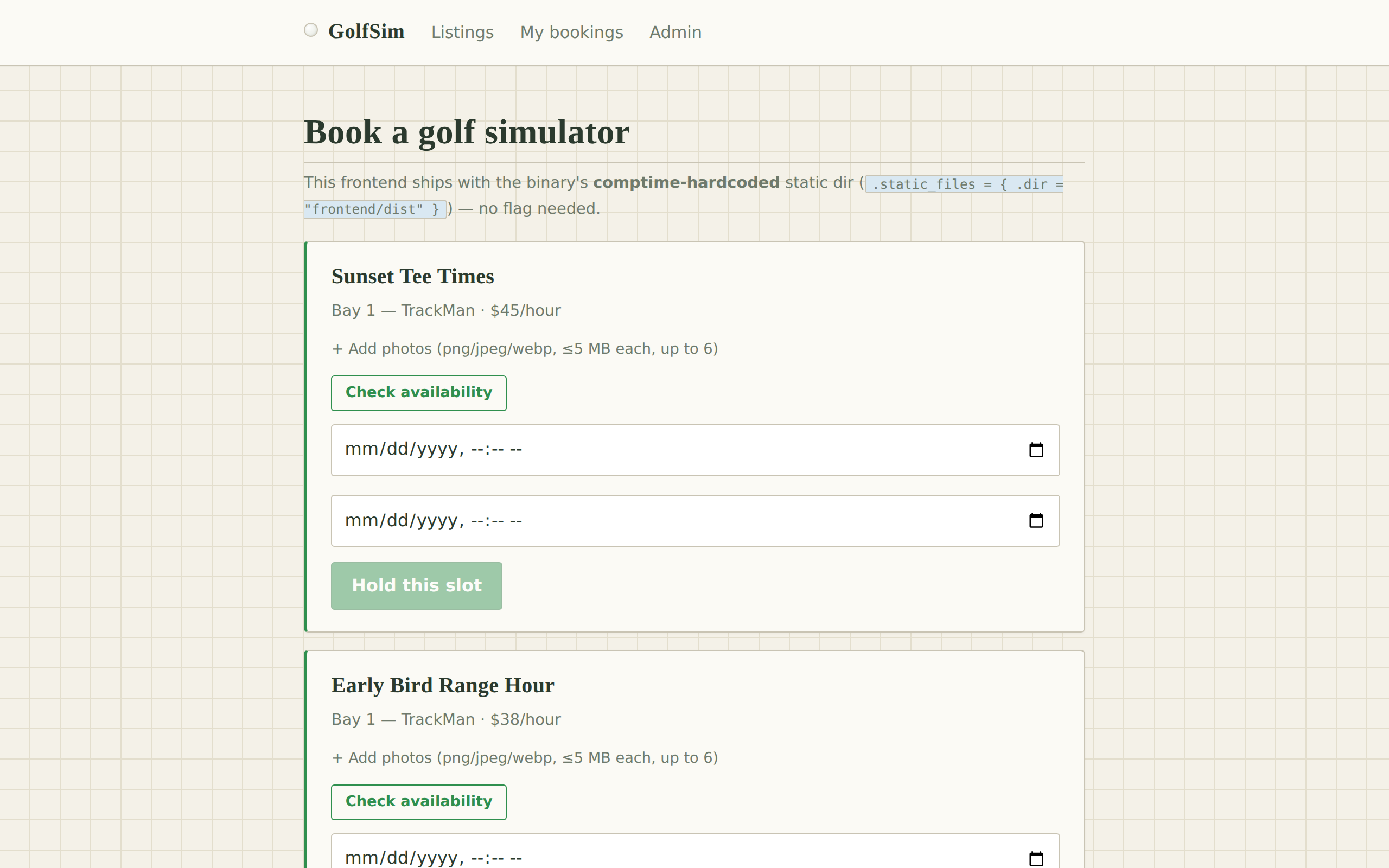
Real apps, in the repo: study the booking app's hooks, routes, jobs, and frontend.
Explore the booking example →Evidence you can inspect
ZigBase is an early release. Explore what works today and the work still ahead.
Start with the blog, explore booking workflows, or study plugins and compile-time configuration. The embedded admin UI gives each app a way to manage its data.
Browse examples →The August 2026 Genesis checkpoint records three successful unattended app-building runs. Results identify their scenario and revision; they do not qualify every later release.
Read the evaluation details →Application capacity measurements, coordinated resource budgets, and growth rehearsals are priorities. Follow the backlog and current limitations as the framework develops.
Explore the engineering backlog →Read current limitations →Your ambition. Your infrastructure. Your code.